
Meeting Yourself on the Curve
Why “Just Catch Up” Is the Worst AI Advice You’ll Ever Get
The Technology Adoption Curve — and Why Your Real Starting Line Is a Mindset, Not a Tool
The Thriving Business Ecosystem — Week 28 of 40
More Success with Less Stress
Author: Steve Goodner
October 5, 2026
The Feed That Felt Like a Verdict
It’s 11:17 on a Tuesday night, and Dana is still awake, thumb moving up her phone screen. She didn’t mean to open LinkedIn. She just wanted to check one message. But now she’s four minutes deep into a feed that feels less like a network and more like a verdict.
A man she met once at a conference has “fully automated” his client onboarding. A woman her age built an entire content engine over a single weekend. Somebody she went to high school with is now, apparently, an “AI strategist.” Every post lands in the same cold spot in her chest — that quiet drop that says you are behind, and the gap is widening while you sleep.
Dana runs a fifteen-person bookkeeping firm she built from a spare bedroom. Her clients adore her. Her team has stayed with her for years. By every measure that mattered for two decades, she is winning. But lately one sentence has been following her around — from a webinar, a software vendor, a well-meaning peer, her own nephew: “You’ve just got to catch up.”
When she told me this over coffee, she said the phrase out loud and then laughed in a way that wasn’t really a laugh. “Catch up to what, Steve? To whom? I don’t even know where the starting line is. I just know everyone keeps telling me I’m behind it.”
I’ve heard some version of that sentence from hundreds of owners this past year. So I’ll tell you what I told Dana, because if that 11 p.m. drop in your chest is familiar, this one is for you: “Just catch up” is the worst AI advice you will ever be given. Not because you have no room to grow — you do. But because it points you at the wrong race, measured against the wrong people, starting from a line that was never even yours.
The Insight: You’re Standing on a Curve — Just Not the One They Mean
Last week we stepped into what I call climate control — the layer of your ecosystem that technology and AI are reshaping whether you volunteered for it or not. A greenhouse doesn’t fear the weather, and it doesn’t fling its doors open to every passing gust either; it works with the climate on purpose. This week we get practical about one piece of that weather: the technology adoption curve, and where you actually stand on it.
The Curve Everyone Quotes — and Gets Wrong
You’ve probably seen the curve even if you’ve never named it. Back in the 1960s, a sociologist named Everett Rogers studied how new ideas spread through a population and found they move in a remarkably consistent, bell-shaped wave. A small sliver of innovators leap first. Then the early adopters — the people everyone else quietly watches. Then the early majority and the late majority, roughly a third each, who climb aboard once the thing is proven. And finally the laggards, who hold out until there is no other option left.
Here is where the advice-givers go wrong. They take that curve, point a finger at you, and say, “Get to the front.” As if the entire game were a footrace and virtue belonged to whoever sprinted hardest toward the newest tool. But Rogers was describing how ideas spread across a whole market — he was not prescribing where any one business owner ought to stand. Being an “early adopter” of the wrong tool for your business isn’t leadership. It’s just an expensive way to arrive first at a destination you never needed to reach. Remember Victor from last week — six tools in ninety days, first to everything, serving no one well.
There Isn’t One Curve. There Are Two.
The real trouble with “just catch up” is that it quietly collapses two very different curves into one.
The first is the market curve — how fast these tools are spreading out in the world. And on that curve, the gap genuinely is closing fast. In a September 2025 analysis, the SBA’s Office of Advocacy suggested that small businesses might be about a year behind larger firms in adopting AI to produce goods or services. The window for an early mover really is open, and it won’t stay open forever. That part is true, and I won’t pretend otherwise.
But the second curve is the one nobody puts on a slide — and it’s the one that actually governs your next move. It’s your personal readiness curve: not how many tools you’ve tried, but how ready you are, on the inside, to meet this moment as yourself. That curve isn’t measured in apps. It’s measured in mindset.
This is the piece owners keep missing. When I sit with someone who feels hopelessly “behind,” nine times out of ten the thing holding them back isn’t technical at all. In my book “Thrive,” I name the real barriers plainly, because they are almost never about prompts or algorithms. They’re emotional. The fear of looking foolish in front of your own team. The identity threat — if a machine can do the thing I built my name on, what does that say about me? The overwhelm of a hundred tools multiplying weekly until you freeze and do nothing at all. The perfectionism that whispers, “I’ll start once I really understand it.” The loss of control. The scar tissue left by the last piece of technology that promised the moon and delivered a headache.
None of those are character flaws. They’re human, and they’re normal. But notice what they share: not one of them is solved by a tutorial. You cannot catch up your way out of an identity threat. And that is precisely why “just catch up” fails the very people who need help most — it hands a technical answer to an emotional question.

Your Starting Line Is Wherever You Actually Are
Underneath every one of those barriers sits a single capacity I call growth readiness — the genuine desire to grow, the openness to honest feedback, and the willingness to act on what you learn. The owners who navigate this moment well aren’t fearless, and they’re rarely the most technical people in the room. They’re the growth-ready ones. They’re willing to be beginners. They move alongside the fear instead of waiting for it to disappear first.
Think back to the puzzle box we opened at the start of this series. You can see some of your pieces. Some you can’t. But how do they fit the bigger picture on the lid? When it comes to AI, here is the piece most owners are surest about and least able to see: they are convinced the question is “which tools am I missing?” when the real question is “where do I actually stand — in my readiness, my leverage, my imagination — and what is the one next step from there?”
And remember, you are not standing on this curve alone. Your team is scattered all across it — a quiet early adopter two desks down already using these tools at home, and someone else carrying a knot of fear they would never say aloud. One of the three emotional environments in this series is your team’s emotional reality, and leading them well starts with knowing where each of them truly stands, not where a headline insists they should be.
The research keeps pointing the same direction. A 2021 meta-analysis covering 65,826 observations found that emotional intelligence had a stronger association with entrepreneurial success than general mental ability. In a season of relentless change, your EQ — your ability to stay grounded, read the room, and move with agility rather than panic — is the most durable advantage you own. The tools will change again next quarter. That won’t.
The Application: Find Your Real Starting Line This Week
You don’t answer the “am I behind?” question by consuming more content about being behind. You answer it by locating your actual starting line and taking one honest step from it. Pick two or three of these and do them this week.
Trade the race question for the readiness question. Instead of “what tools am I missing?” ask three better ones out loud, and answer honestly. Am I ready to adopt — can I try something new without needing to master it first? Am I getting leverage — are the tools I already touch actually lifting work off my plate? And am I using any imagination — can I picture AI doing something for my business beyond what I’ve watched others do? Your weakest answer is your real starting line. Start there.
Audit your inputs, not just your tools. That 11 p.m. feed is not a market report. It’s a highlight reel — other people’s wins with the failures edited out. For one week, notice what you consume about AI and how it leaves you feeling. If an account leaves you anxious and frozen rather than clear and curious, mute it. You cannot make a grounded decision from a flinch.
Map your team on the curve — gently. Write down your people and take a quiet guess at where each one stands: who’s already experimenting, who’s capable but cautious, who’s quietly afraid. You’re not grading them; you’re learning the terrain you lead. Then ask your likeliest early adopter one question: “What are you already using that’s helping you?” You may find your firm is further along than your feed suggested.
Take the adjacent step, not the leap. “Catch up” tells you to sprint to the front. Don’t. Pick up the one experiment you started last week and take the single next step from it — nothing more. One tool, one drain, one step. Momentum on this curve is never built by giant leaps; it’s built by the next honest move, repeated until it becomes a habit.
And sit with two reflective questions this week.
Where am I measuring my inside against everyone else’s outside — and what would change if I simply stopped?
If I knew exactly where I stood right now, with no shame attached to the answer, what one step would obviously come next?
Write both answers down. The first dissolves a fear that was never real. The second hands you a plan that is.
Going Deeper
If Dana’s 11 p.m. scroll sounded like one of your own nights, here is the encouraging part: “behind” is not a fact about you — it’s a feeling manufactured by comparing your real life to a curated feed. The honest question was never how far back you are; it’s where you actually stand and what comes next. That’s exactly what we built the AI Readiness Edge™ to show you. It doesn’t test whether you can code or how many apps you’ve tried — it measures mindset, not skill: your Adoption Readiness, your Applied Leverage, and your Creative Capacity, so your real starting line stops being a mystery you lose sleep over and becomes a place you can take a step from. For a first, no-pressure look, start with the free Success Pathway Snapshot at eqfit.org — a quick read on the patterns shaping how you’ll meet this moment.
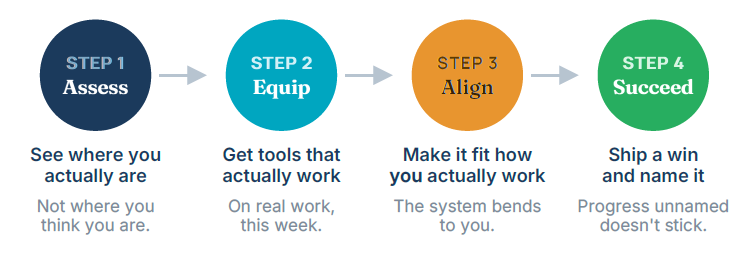
That’s the Assess in Assess → Equip → Align → Succeed, and it’s where more success with less stress begins.
Next week we stay in climate control and get specific about the tools themselves — because the goal of automation was never to make your business more robotic. In “Automation That Serves People (Not the Other Way Around),” we’ll separate the kind of automation that frees you for what matters from the kind that quietly slides a machine between you and the people you serve. Bring your starting line with you. Now that you know where you stand, you’re ready to move.
© 2026 — EQFIT® — All rights reserved.