
Data-Driven Decisions
Using Assessments to See What Intuition Misses
Your Gut Is a Brilliant Instrument — With One Blind Spot It Can Never See on Its Own
The Thriving Business Ecosystem — Week 30 of 40
More Success with Less Stress
Author: Steve Goodner
October 19, 2026
The Promotion Elena Was Sure About
Elena made the call in about four seconds, and she’d have bet the business on it.
Ray was the obvious choice — eight years on her team, the sharpest installer she’d ever hired, the one who stayed late without being asked and fixed the jobs nobody else could. When her lead tech retired and she needed someone to run the crew, she didn’t even write a job description. She walked out to the van, handed Ray the keys, and said, “It’s yours.” Her gut had never steered her wrong in twenty-two years of building her home-services company from a single truck. Why would it start now?
Four months later she sat across from me with her coffee going cold, trying to understand how the surest decision she’d made all year had quietly cracked her best crew down the middle. Two good people had given notice. Ray was miserable. The work was slipping. Her instincts hadn’t just missed this — they’d walked her straight into it.
“Steve, I read people for a living,” she said. “So how did I misread the one who mattered most?”
I’ll tell you what I told her, because if you’ve ever trusted your gut completely and been blindsided anyway, this one is for you: your instincts aren’t broken. They’re built to see one layer — and the decision that mattered was hiding in the layer underneath.
The Insight: Your Gut Sees One Layer — Assessments See the Other
For the last few weeks we’ve been living in what I call climate control — the layer of your ecosystem that technology and AI are reshaping whether you volunteered for it or not. A greenhouse doesn’t fear the weather, and it doesn’t fling its doors open to every passing gust either; it works with the climate on purpose. This week the weather is data — the dashboards, the metrics, the assessments every tool now hands you — and the question underneath it all: when do you trust the data, and when do you trust your gut?
The honest answer isn’t “trust the data,” and it isn’t “trust your gut.” It’s learn what each one can see — and what it can’t.
Your Gut Is a Genius — With One Blind Spot
Let me not dismiss your instincts, because they’re one of the most remarkable instruments you own. What we casually call “gut” is pattern recognition running faster than your conscious mind can follow — years of hard-won experience compressed into a feeling that arrives before you can explain it. Elena’s read on who could do the work was built on twenty-two years of being right. That instinct is real and valuable.
But here’s the catch that trips up even seasoned owners: your intuition can only be built from what you’ve been able to see. It brilliantly reads the patterns you’ve been shown over and over — and stays blind to the ones you never have. The psychologist Daniel Kahneman named this the illusion of validity: our tendency to feel most confident exactly when we have the least reason to be. Certainty isn’t evidence that you’re right — and it runs strongest in the two places intuition is weakest: reading what’s really going on inside other people, and reading yourself.
The Layer Your Intuition Can’t Reach
Think about Elena’s four-second decision. What did her gut actually read? Everything it could see: Ray’s skill, his work ethic, his track record, his loyalty. All of it accurate — and all of it on the top of the box.
Everyone can see the pieces on top of the box — your skills, your experience, your track record. But underneath those sit the pieces nobody can see: the mindset, the drivers, the patterns that decide how the visible pieces fit. That’s what an assessment does — it lifts out the layer underneath.
Ray’s whole sense of worth was wired to doing the work himself, to his own standard. Put him in charge of people and that same wiring — the pattern that made him a brilliant installer — became a leader who couldn’t delegate and couldn’t let a job be done ninety percent his way. None of that was a character flaw, and none of it showed on top of the box. It was the layer underneath, and instinct had never been shown it. An assessment could have — not as a verdict on Ray, but as a map of how he’s wired, before Elena handed him the keys.

The Hardest Person to Read Is You
If your intuition struggles to see the hidden layer in other people, there’s one person it reads even worse: you. We’re all standing inside our own puzzle box, trying to describe a picture we’re too close to see.
The research here is humbling. Organizational psychologist Tasha Eurich surveyed thousands of people and found that about 95 percent of us believe we’re self-aware — while only an estimated 10 to 15 percent actually are. Most of us are convinced we see ourselves clearly, and most of us are wrong. It shows up on the bottom line, too: in one study of 486 companies, those with more self-aware leaders consistently outperformed the rest — and the poor performers had 20 percent more leaders with significant blind spots.
That’s the quiet cost of running on gut alone — not that your instincts are bad, but that the instrument doing the measuring, your own self-perception, has a blind spot it can’t detect by trying harder. You need an outside view. In my book Thrive, I describe self-awareness as the flashlight that illuminates what’s been operating in the dark — and a good assessment is one of the most reliable flashlights we have. It doesn’t tell you who you should be; it reveals who you already are, so you can finally operate from that truth.
Data That Still Needs You to Read It
Now, before you swing to the other extreme and hand the numbers the wheel — that’s its own expensive mistake. Owners who trade their judgment for a dashboard end up just as blindsided as the ones who ignore data completely.
Data does help — the data-informed owner really does outperform the gut-only one. A landmark MIT study by Erik Brynjolfsson and colleagues found that firms adopting genuine data-driven decision-making show output and productivity roughly 5 to 6 percent higher than comparable firms that don’t. But notice the word: informed. The data doesn’t make the decision. You do.
Here’s the line to carry out of this post: a number shows you the what, but only you can read the why. Revenue dipped — the spreadsheet says so. Whether that’s a seasonal lull, a quality problem, or a key client quietly drifting the way we talked about last week, the number will never tell you. AI can surface patterns at a speed no person can match, but it cannot sense the unspoken concern in a client’s voice. That reading is judgment, and it’s yours. The goal was never gut versus data — it’s judgment with better inputs.
And one more thing, because it matters most. When the data is about a person — their patterns, their wiring, their scores — it’s a tool for development, never a verdict. The EQFIT® Edge™ assessments exist to grow people, not to sort them; they’re never meant to decide who gets hired, promoted, or let go. A score is not a sentence — it describes how someone tends to operate right now, and the whole point is that it can move. Elena’s assessment didn’t tell her to demote Ray; it gave her the map to develop him — and to finally see the pattern in herself that mistook being best at the work for being ready to lead the people.
The Application: Put Your Instincts to the Test This Week
You don’t fix a blind spot by squinting harder at it — that’s what makes it a blind spot. You fix it by deliberately inviting in a view you can’t generate on your own. Pick two or three of these and do them this week.
Name the gut call you’d bet the business on. Write down one decision you’re making on instinct alone — a hire, a promotion, a pricing move, a “this client is fine” assumption. Then split it in two: what can I actually see here (the top of the box), and what am I assuming about the layer underneath? Naming that gap often slows a four-second decision down to a wise one.
Run the what-versus-why test on one number. Pick a single metric you’ve been reacting to — a dip, a spike, a slow month. In one column write only what the number literally shows; in the other, the why you’ve been assuming. Then ask: do I actually know that why, or did my gut fill it in? If you drew the two lists we built last week, you already have the muscle for this.
Invite one honest outside view of yourself. You can’t close a self-awareness gap from the inside. Ask three people who’ll tell you the truth the same question — “What’s one thing I do under pressure that I might not see?” — or take a real assessment built to lift out the hidden layer. Brace yourself to be a little surprised. That surprise isn’t failure; it’s the flashlight finding something that was always there.
Treat every assessment as a conversation, not a scorecard. If you hold data on someone on your team — a profile, a review, a score — resist the pull to file them under it. Sit down with one person this week and use what you know to ask better questions, not to hand down a verdict. You’ll grow them — and learn how much the number left out.
And sit with two reflective questions.
Where am I most certain — and have I ever checked that certainty against anything outside my own head? Your highest confidence is exactly where your blind spots hide best.
If I could see one hidden piece — in a key person, or in myself — what would I most not want it to reveal?
The first keeps your instincts honest; the second usually points straight at the piece worth looking for.
Going Deeper
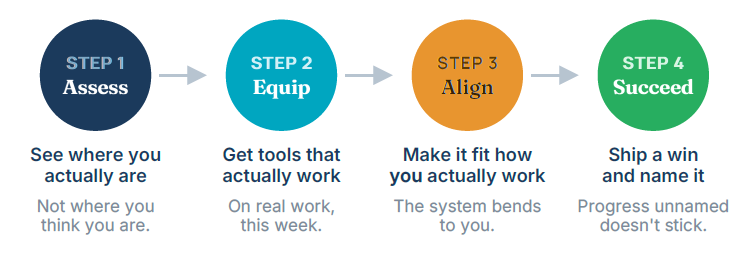
If Elena’s four-second decision sounded like one of your own, here’s the encouraging part: the goal was never to stop trusting your gut. It’s to give your gut something it’s never had — a clear view of the layer underneath, in your people and in yourself. That’s what we built the EQFIT® assessment suite to do. The EQFIT® Patterns & Pathways™ Profile pulls that hidden layer into the light — the mindset, drivers, and patterns that decide how all your visible pieces fit — so your judgment finally has the data it’s been missing. Not a verdict on anyone; a map for growing them. For a first, no-pressure look, start with the free Success Pathway Snapshot at eqfit.org. That’s the Assess in Assess → Equip → Align → Succeed, and it’s where more success with less stress begins.
Next week we stay in climate control and connect the tools themselves. In “Your Digital Ecosystem: When Tools Talk to Each Other, Magic Happens,” we’ll look at what happens when the systems you’ve been bolting on one at a time finally start working as one — and why the magic was never in any single app. Bring this week’s lists with you. You’re going to put them to work.
© 2026 — EQFIT® — All rights reserved.