
When Tools Talk to Each Other, Magic Happens
The Thriving Business Ecosystem — Week 31 of 40
More Success with Less Stress
Your Digital Ecosystem: When Tools Talk to Each Other, Magic Happens
Why the Breakthrough You Keep Shopping For Was Never Hiding in the Next App You Buy
Author: Steve Goodner
October 26, 2026
The Twelve Tabs Marcus Couldn’t Close
Marcus opened his laptop a little after six, the way he did every morning, and counted the tabs before he counted anything else. Twelve. There were always twelve. His CRM. Two email inboxes. The scheduling app. The invoicing software. The project tracker. A spreadsheet he swore he’d retire someday. The texting tool his crews actually answered. The accounting login he avoided. He ran a small design-build remodeling firm — eleven people, a good name in town, a full calendar — and somewhere along the way he had bought a tool for every problem he’d ever had. He’d been proud of that, once.
Then came the Tuesday that still stung. A woman had filled out the quote form on his website on a Thursday night — a full kitchen remodel, exactly the kind of job he loved. The form dropped her message into an inbox he only checked on Mondays, and by Monday he was buried in the project tracker finishing a punch list. By the time he saw her note, nine days had passed. She had already signed with the firm across town. “Your website said you’d get back to me within a day,” she wrote, kindly, which somehow made it worse.
He told me about it with his coffee going cold. “Steve, I’ve got software for everything. I enter the same customer’s name into four different apps before lunch. So why does it feel like I’m the duct tape holding the whole thing together? Like the only place all these tools actually connect is inside my own tired head?”
I’ll tell you what I told Marcus, because if you have ever stared at your own row of tabs wondering why more tools left you more scattered, this one is for you: you don’t have a tool problem. You have a connection problem. And the breakthrough you keep shopping for was never going to arrive in the next app you buy.
The Insight: A Pile of Tools Is Not a System
For the last few weeks we have been living in what I call climate control — the layer of your ecosystem that technology and AI are reshaping whether you asked them to or not. Hold on to the posture we set for this phase: a greenhouse doesn’t fear the weather, and it doesn’t fling its doors open to every passing gust either. It works with the climate on purpose. Last week we read our data without outsourcing our judgment. This week we turn to the tools themselves — and to the quiet truth that the magic was never in any single one of them.
The Franken-Stack You Didn’t Mean to Build
Here’s how almost every business ends up where Marcus is, and it is nobody’s fault. You hit a problem, so you buy a tool. Leads are slipping — get a CRM. Invoices go out late — get invoicing software. Each choice was smart on its own. But you made them one at a time, over years, and nobody ever stepped back to ask whether the tools could talk to each other. So they don’t. You end up with what I half-jokingly call a Franken-stack: a dozen capable apps stitched together by the one integration never designed for the job — you.
And that stitching is expensive in a way that never shows up on an invoice. A 2022 study published in the Harvard Business Review found that the average worker toggles between apps and websites nearly 1,200 times a day — switching that added up to roughly four hours a week just reorienting, finding your place again after each hop. That is the better part of a workday, every week, spent climbing back into the work instead of doing it. And the attention cost runs deeper than the clock shows: research by Dr. Gloria Mark at the University of California, Irvine found it takes an average of about 23 minutes to fully refocus after your attention is pulled away. You are paying that tax in the one currency you can never earn back.

An Ecosystem Is Defined by Its Connections
Here is the shift that changed everything for Marcus — the same idea that has run underneath all thirty-one weeks of this series. A thriving ecosystem is not defined by its parts. It is defined by how those parts connect. A forest is not a warehouse of trees; it is a living web of roots, soil, water, and light feeding one another. Pull the connections out and you don’t have a smaller forest — you have a pile of lumber.
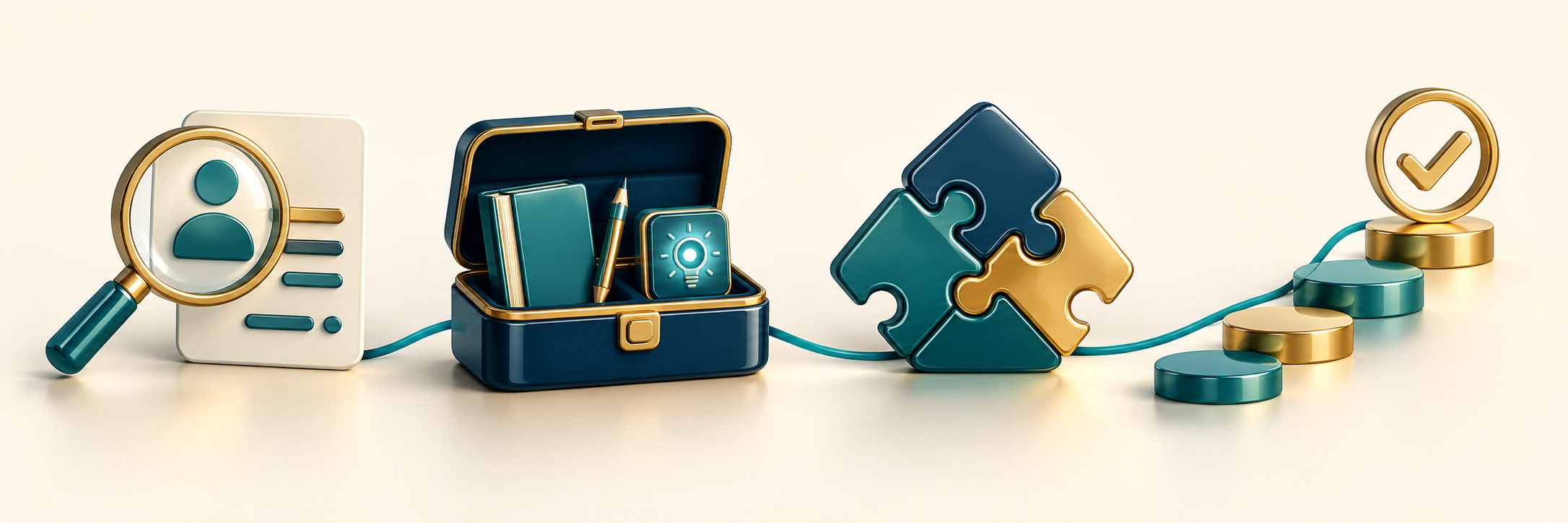
Your digital world works exactly the same way. Twelve excellent apps that don’t talk to each other are not a system; they are a pile. And just like the puzzle box we keep coming back to, the part that matters most is the part you can’t easily see. Everyone can see the tools on top of the box — the logos, the dashboards, the apps you pay for every month. But the magic, or the mess, lives underneath, in the connective tissue between them: the handoffs where a lead becomes a client, where a booking becomes an invoice, where a customer’s information has to move from one place to the next. That hidden layer is exactly where Marcus’s kitchen remodel fell through — and it is where yours is quietly leaking too.
This is element four of what I call Your Success Ecosystem™ — your Operating System: the routines, tools, AI, and workflows that decide how the work actually gets done. A Success Ecosystem is what you get when disparate pieces are pulled into one connected system that reinforces itself — more success with less stress. The goal was never to own the most tools. It is to make the tools you already own work as one.
The Plumbing Exists to Protect the Human Moment
Let me be clear about why this matters, because it would be easy to hear this as a pitch for more automation — and it isn’t. When your tools finally connect, the point is not that your business becomes more of a machine. It is that you become free to be more human. Every hour you spend re-typing a customer’s address into a fourth app is an hour not spent on the call, the follow-up, the note that makes a client feel known. And that human moment is not a nice-to-have. Research in the Journal of Consumer Psychology found that customers who feel emotionally connected to a business are worth more than three times as much over their lifetime as customers who are merely satisfied. The connection you build by hand is the most valuable thing you make — and a connected ecosystem exists to guard it, taking the robotic work off your plate so the relational work can have you at your best.
One honest caution, because a greenhouse always keeps a hand on the door. Connecting tools just for the sake of it is its own trap — build a fragile contraption and you end up debugging software instead of running a business. So never start with the app. Start with the human outcome you are protecting — the lead that should never wait nine days, the client who should always feel remembered — and build only the connection that serves it. The tool follows the workflow. The workflow follows the person.
The Application: Map Your Ecosystem Before You Add to It
You don’t fix a connection problem by buying a thirteenth tool. You fix it by seeing the stack you already have as one system — then connecting the single seam costing you the most. Pick two or three of these and do them this week.
Draw your whole stack on one page. Open a blank sheet and write down every app, login, and spreadsheet your business runs on. All of them. Most owners are quietly stunned by the real number — they have never looked at the whole picture at once. You cannot connect a system you cannot see.
Trace one customer from hello to paid. Pick a single recent client and walk their journey step by step: the form, the reply, the call, the quote, the booking, the invoice, the follow-up. At each step, note which tool holds the information and how it reaches the next. Circle every handoff where you are the integration, carrying the data across yourself. Those circles are your leaks.
Count the double-entry. For one day, tally every time you type the same piece of information — a name, an email, an address, an amount — into more than one place. That number is your swivel-chair tax, and it is almost always the first connection worth making.
Connect one seam, not twelve. Resist the urge to redesign everything at once. Choose the single highest-friction handoff from your customer trace and connect just those two tools, so the information flows on its own. Most modern apps already talk to each other, or will through a simple connector. One clean connection you trust beats ten clever ones you don’t.
Name the human moment you are buying back. Before you connect anything, finish this sentence: “When this runs on its own, I’ll use the time it gives me to ____.” If you cannot name the human work you are protecting, you are just automating for its own sake. The freed hour has to land somewhere that matters.
And sit with two reflective questions this week.
Where does a customer’s experience depend entirely on me remembering to move something from one place to another? That seam is the one most likely to fail on your busiest day — the very day it matters most.
If my tools handled the handoffs, where would I spend the hours they gave back, so a client felt more known rather than more processed?
The first question shows you the leak; the second tells you what the repair is for.
Going Deeper
If Marcus’s twelve tabs looked a little like your own this morning, here is the encouraging part: you are not behind, and you do not need to become a software engineer to fix this. You need to see your tools as one ecosystem and connect them on purpose, starting with the seam that costs you most. But here is the deeper truth we keep circling back to — your digital ecosystem is only ever as clear as the person configuring it. The tools reflect the wiring of their owner: how you think about systems, how you handle change, where your instincts serve you and where they quietly get in the way. That is exactly what we built the EQFIT® AI Readiness Edge™ Assessment to reveal. It doesn’t test whether you can code or how many apps you have tried — it measures mindset, not skill: your Adoption Readiness, your Applied Leverage, and your Creative Capacity. For a first, no-pressure look, start with the free Success Pathway Snapshot at eqfit.org. That is the Assess in Assess → Equip → Align → Succeed, and it is where more success with less stress begins.
Next week we stay in climate control and turn from the tools to the person holding them. In “The AI-Savvy Leader: Emotional Intelligence in a Machine-Learning World,” we’ll look at the one capability that decides whether all this technology makes you more of a leader or less of one — and why, in the age of the machine, your emotional intelligence is the most future-proof skill you own. Bring your stack map with you. You’re going to need it.
© 2026 — EQFIT® — All rights reserved.