
Future-Proofing Your Business
The Thriving Business Ecosystem — Week 34 of 40
More Success with Less Stress
Future-Proofing Your Business:
Adaptation as a Core Competency
Why the Businesses That Last Aren’t the Ones That Guessed Right —
They’re the Ones That Learned to Bend
Author: Steve Goodner
November 16, 2026
The Binder Full of Predictions
For twenty-two years, Raymond had a gift for seeing around corners.
He ran a commercial print shop in a town where three others had already closed, and he’d outlasted them all by reading the tea leaves early — buying the digital presses before his competitors did, jumping on wide-format signage first. On the wall behind his desk hung a row of black binders, one for every “next big thing” he’d bet on. He called it his edge. “Other guys react,” he told me once, with a grin. “I predict.”
Then came the year the corner he was watching turned out to be the wrong one.
He had sunk nearly everything into a specialty technology he was certain would own the next decade. Reasonable bet. Wrong bet. The market shifted in a direction none of his binders had a page for, and it shifted fast — and six months later he was staring at equipment he couldn’t pay off and a prediction that had aged like milk.
What haunted him wasn’t losing the bet. It was Donna — who ran a smaller shop two towns over and had never struck Raymond as the visionary type. “She never seemed to bet on anything,” he said. Yet when the same shift hit her, she bent with it and kept standing. By the time Raymond called me, she had quietly picked up two of his biggest accounts.
“Steve, I don’t get it,” he said. “I’ve spent my whole career trying to predict the future, and I got it wrong at the worst possible moment. She didn’t see it coming either. So how is she the one still standing?”
That’s the whole point of this post. Donna wasn’t better at predicting the future — she had built something better than prediction.
The Insight: You Can’t Future-Proof by Predicting the Future
For seven weeks now we’ve been living in what I call climate control — the layer of your ecosystem that technology, automation, and AI are reshaping whether you invited them to or not. We’ve walked through adoption curves, automation, data, digital ecosystems, the AI-savvy leader, and, last week, systemizing without losing your soul. This is the last stop in that phase. Before we leave it, I want to lift our eyes from the tools in your hands to the horizon — because every owner I meet eventually asks some version of Raymond’s question: how do I make sure my business is ready for whatever comes next?
For most of them, “ready” secretly means “right” — I want to pick the winning tool, the winning trend, the winning bet. But that’s the wrong target, and aiming at it is quietly exhausting you.

The Myth of Seeing Around Corners
Here’s a number worth sitting with. The U.S. Bureau of Labor Statistics has tracked business survival for decades, and the pattern barely moves: only about half of new businesses make it to five years, and only about a third reach ten. It isn’t that those owners are lazy or foolish — plenty of smart, hardworking people land in the half that doesn’t make it. What separates the survivors is rarely that they predicted better.
And the ground is moving faster under all of us. Research from the firm Innosight found that a company could expect to stay on the S&P 500 for about 33 years back in the 1960s; by 1990 that had fallen to around 20, and they project it will keep shrinking into the mid-teens this decade. Even the giants, with whole departments devoted to forecasting, are being replaced faster than ever. If prediction were the answer, they’d be the safest companies on earth. They’re not.
There’s an old line, often credited to Darwin, that it is not the strongest or the most intelligent of a species that survives, but the one most adaptable to change. Darwin didn’t actually write those words — a business professor paraphrased him a century later — but the idea has outlived the misquote because it’s true. Survival goes not to the one who sees the future most clearly, but to the one most able to respond to a future nobody saw clearly.
Agility: Fast in the Right Direction In my book THRIVE, I describe two capabilities that together form the real operating system of a future-ready business. The first is agility. Agility is the ability to take advantage of opportunity with speed and efficiency. Notice what that is — and what it isn’t. Anyone can be fast in the wrong direction. Raymond was blazingly fast — he just sprinted off a cliff. Agility is being fast in the right direction: the capacity to meet a new tool or shift with clarity instead of chaos. And here’s what most people miss — real agility is not reactivity. Reactivity is chasing every signal, lunging at every shiny thing; that isn’t adaptation, it’s thrashing, and it burns you out. True agility comes from the opposite place: a stable center — a clear sense of who you are, how you’re wired, and where you’re headed — that lets you filter the noise instantly. From that center you give a fast yes to the few opportunities that fit, and a fast no to the dozens that merely glitter. In an age of infinite AI tools and endless advice, the confident no is one of the most powerful forms of agility there is. That was Donna’s edge — not prediction, but a center steady enough to move from when the ground shifted. |  |
Resilience: Built to Bend, Not Just to Endure
The second capability is resilience — and here I have to correct a model most of us inherited.
Most owners think resilience means toughness: absorbing the blows, outworking the problem, refusing to quit. But toughness alone has a predictable endpoint, and it’s called collapse. The owner grinding through every storm on sheer will isn’t resilient — they’re depleting. The research bears this out: the World Health Organization now classifies burnout as an occupational phenomenon, and studies put the burnout rate among entrepreneurs north of 60 percent. The toughness model isn’t a badge of honor. It’s a slow-motion crisis dressed up as a work ethic.
Real resilience is something else. I call it being a renewable owner — protecting your four most precious internal resources (time, energy, focus, and effort) so that when the storm hits, you have reserves to meet it. Think of two owners from THRIVE. Carmen entered her crisis already running on fumes, and it broke her. Will entered his with reserves intact — guarded mornings, a true day off, work that renewed him rather than drained him — and the same storm was a challenge, not a catastrophe. Within weeks he was back to full capacity, because he’d never let himself get depleted.
That’s the quiet truth about every storm: the outcome is mostly decided before it arrives, by the reserves you were carrying when it hit. Adaptation needs fuel. Resilience is how you keep fuel in the tank.
Why Adaptation Is a Mindset, Not a Tool
Put agility and resilience together and you have something no competitor can copy from you: the capacity to meet a future you didn’t predict, move on it quickly, and absorb the hits without breaking. That is what future-proofing actually means. Not the right tool — the right capacity.
Which is why you cannot buy your way to a future-proof business; there is no subscription to adaptability. When we built the EQFIT® AI Readiness Edge™ Assessment with my colleague Robert Randall, we designed it to measure what most people get backwards. It doesn’t measure technical skill — whether you can operate this or that app — it measures mindset: your Adoption Readiness (how you meet change), your Applied Leverage (how you put new capability to work), and your Creative Capacity (how you imagine new possibilities). Skills go obsolete on a schedule; the tool you mastered last quarter may be gone next year. But the mindset that lets you keep learning, keep bending, keep moving never goes obsolete. That’s what future-proofs everything else.
The Piece You Can’t See
And just like the puzzle box we keep returning to, the piece that mattered most was the one Raymond couldn’t see. His binders and presses and predictions sat on top of the box, in plain view. Underneath sat the hidden piece: a quiet belief that his value was in being right — that being the one who saw it coming was his identity. So when he got it wrong, it didn’t just cost him money; it shook who he thought he was. That belief, not the bad bet, was the real vulnerability.
You can see some of your pieces. Some you can’t. The real question is how they fit the bigger picture. And here is the test that tells adaptive capacity from mere reaction: does this response come from my center, or from my fear? Fear chases, and fear freezes; a clear center bends and keeps moving. One more time, in the words I’ve used for forty years: the system serves the person, never the other way around — and so does every tool, trend, and prediction you will ever meet.

The Application: Build Your Adaptive Capacity This Week
You don’t future-proof your business by guessing harder. You build the two capacities that let you thrive in a future you can’t see — agility from a clear center, resilience with reserves in the tank. Pick two or three of these this week.
Finish the sentence that reveals your center. “No matter what changes in my industry, the thing my customers will always need from me is ____.” If you can answer that cleanly, you have a center to adapt from. If you can’t yet, that’s not a failure — it’s the most important work you have, because everything downstream depends on it.
Run your next big decision through the pathway filter. For the next tool, trend, or opportunity you’re tempted by, ask four quick questions: Does this fit how I’m actually wired? Does it energize me or drain me? Can I realistically learn it? Does it serve the customer I’m here to serve? Four questions, thirty seconds. Agility is fast because the filter is clear.
Do a resource audit. On a scale of one to ten, rate your four reserves right now — time, energy, focus, effort. Be honest. These are the fuel adaptation runs on, and you can’t bend when you’re already empty. Your lowest number is where the next storm will find you.
Build one non-negotiable renewal practice. Will had his Wednesdays. Pick one thing that genuinely refuels you — not what should refuel you, but what actually does — and make it non-negotiable before the pressure comes. The things that renew us are always first to be sacrificed when we’re busy, which is exactly why they can’t be optional.
Separate the signal from the noise. Pull out the R-and-H list you made last week — robotic work versus human work. Add a third pass: of the new tools and trends shouting for your attention, which three actually touch your human, irreplaceable work, and which are just noise dressed up as urgency? Give those three a real look. Let the rest go without guilt.
Then sit with two questions this week. First: when change hits, do I respond from my center, or from my fear? Second: if a storm arrived next month, would it find me with reserves — or running on empty? The first builds your agility; the second builds your resilience. Together, they build a business that’s ready for anything.
Going Deeper
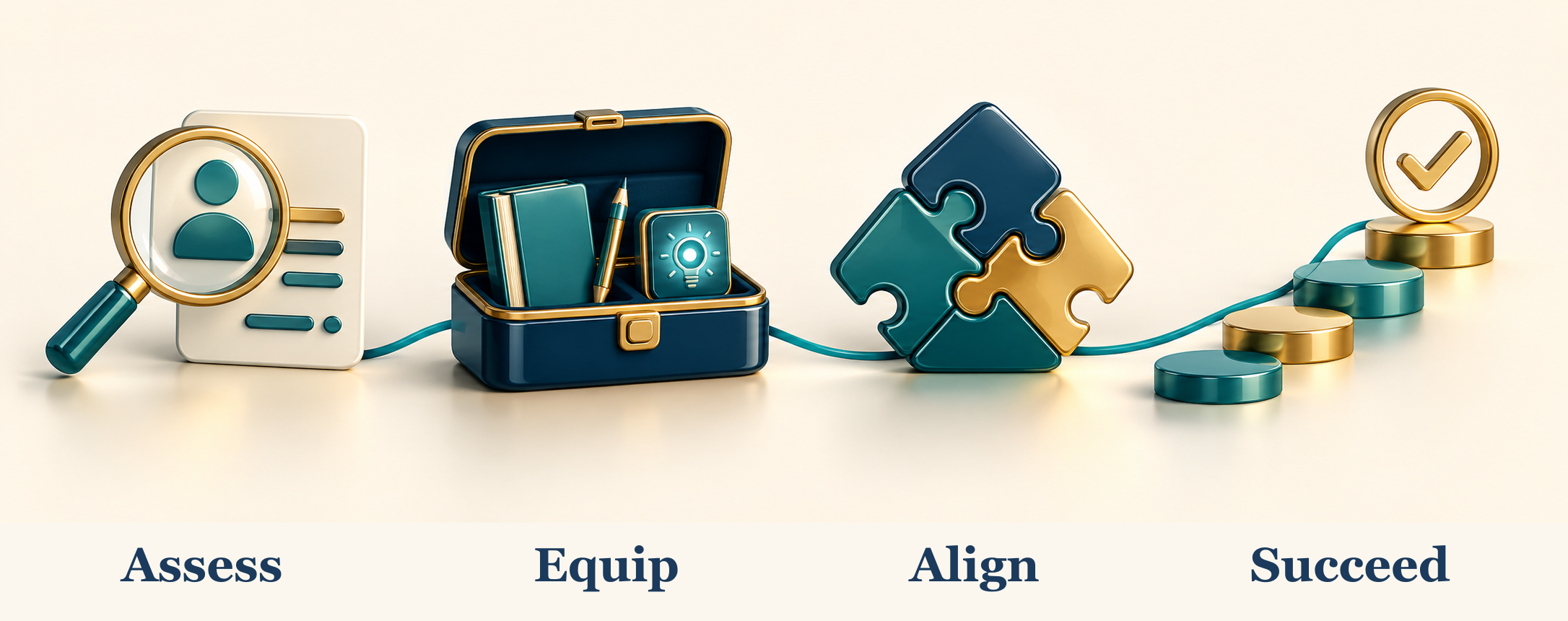
If Raymond’s wall of binders looked a little like your own need to always guess right, take heart. You don’t have to see the future. You have to become the kind of owner — and build the kind of business — that can meet it. But adaptation has to start from a clear picture of who you actually are: your wiring, your drivers, the center you adapt from. That’s the whole EQFIT® approach: Assess → Equip → Align → Succeed. The EQFIT® AI Readiness Edge™ Assessment is built to measure the mindset that future-proofs everything — not your skills, but your readiness to adapt. And for a first, no-pressure look at the pieces on your own puzzle box, start with the free Success Pathway Snapshot at eqfit.org. That’s the Assess in Assess → Equip → Align → Succeed — and it’s where more success with less stress begins.
Next week we step into the final season of the series. We’ve spent thirty-four weeks tending the roots, the soil, the growth engine, and the climate — now we get to talk about the fruit. In “From Hustle to Harvest: What a Thriving Ecosystem Actually Produces,” we’ll look at what all of this has been for — the results a healthy business grows naturally when every layer finally works together.
© 2026 — EQFIT® — All rights reserved.