The Inner Operating System Every Business Runs On
EQFIT® Blog Article
The Thriving Business Ecosystem — Week 3 of 40
More Success with Less Stress
Author: Steve Goodner|April 2026
Two entrepreneurs. Same town. Same industry. Same launch year.
Daniel and Sarah both opened consulting practices in the same mid-sized city the same spring. Similar credentials — both had spent fifteen years in corporate roles before going independent. Similar starting capital, networks, and early pipelines. On paper, you would have bet on them as equals.
Three years later, their businesses looked nothing alike.
Sarah's practice had grown from a solo shop to a team of four. Her calendar was booked six weeks out. Referrals were coming in faster than she could respond to them. She had started taking Fridays off — and, by her own description, she was "more myself than I've ever been."
Daniel was on the verge of closing up. He had hired and lost two assistants. He had changed his niche three times. He was working sixty-hour weeks and losing money most quarters, exhausted and quietly ashamed that the thing he had been so sure he could build was slipping through his fingers.
When I sat down with each of them, I asked the same questions. I looked at pricing, offers, marketing, systems. On nearly every visible dimension, their businesses were close to identical.
The difference wasn't in the business — it was inside the business owner. Daniel and Sarah were running the same software on very different operating systems.
Every Business Runs on a Human Operating System
Here is something we do not talk about nearly enough: no business runs itself. Every decision that shapes your company — every hire, every client yes, every client no, every pricing change, every hard conversation, every moment you push forward and every moment you freeze — passes first through the nervous system of the person at the top.
In my book THRIVE: Finding Your Entrepreneur's Edge in the Age of AI, I describe this invisible layer as the inner operating system — backed by four decades of coaching work and a growing body of neuroscience research. Your brain has been shaped by genetics, experience, and thousands of decisions into a system that processes information, responds to challenges, and connects with others in ways that are distinctly yours. It influences how you handle pressure, what motivates you when things get hard, how you build trust, what drains you, what energizes you, and how you make decisions under uncertainty.
When that inner operating system is healthy and well-understood, your business feels lighter — even when it is hard. Strategy flows from clarity. Difficult conversations do not throw you off for weeks. Opportunities feel like invitations rather than threats. When the operating system is glitchy or invisible to the person running it, the same external circumstances produce struggle, second-guessing, and quiet exhaustion.
Here is the part most entrepreneurs never hear: your brain processes emotional information before it processes logical information. Emotional signals reach the amygdala in milliseconds — faster than the prefrontal cortex can engage in rational analysis. By the time you are "thinking" about a situation, you have already had an emotional response to it, and your logical mind is doing its work inside a frame that has already been colored. A business owner who cannot see the emotional layer of their own decision-making is flying without half of their instruments.
Last week, we talked about the puzzle box — how you can see all your pieces but cannot see the picture on the lid. Your inner operating system is that picture. It tells you how the pieces actually fit together in you.
The Five Dimensions That Make It Run
Researchers have spent the last thirty years mapping this inner system, and a remarkably consistent picture has emerged. Emotional intelligence — EQ — rests on five interlocking dimensions. These five form the core of your inner operating system, the layer beneath your strategy where your business is actually won or lost.
Sit with this number for a moment. A landmark 2021 meta-analysis of more than 65,000 entrepreneurs, published in the Strategic Entrepreneurship Journal (Allen, Stevenson, O'Boyle, & Seibert, 2021), found that emotional intelligence competencies explain 89.1 percent of the variance in entrepreneurial success. IQ explains only 10.9 percent. Nearly nine-tenths of what separates thriving entrepreneurs from struggling ones is not strategy, capital, market timing, or raw intelligence — it is the dimensions of the inner operating system we are about to walk through.
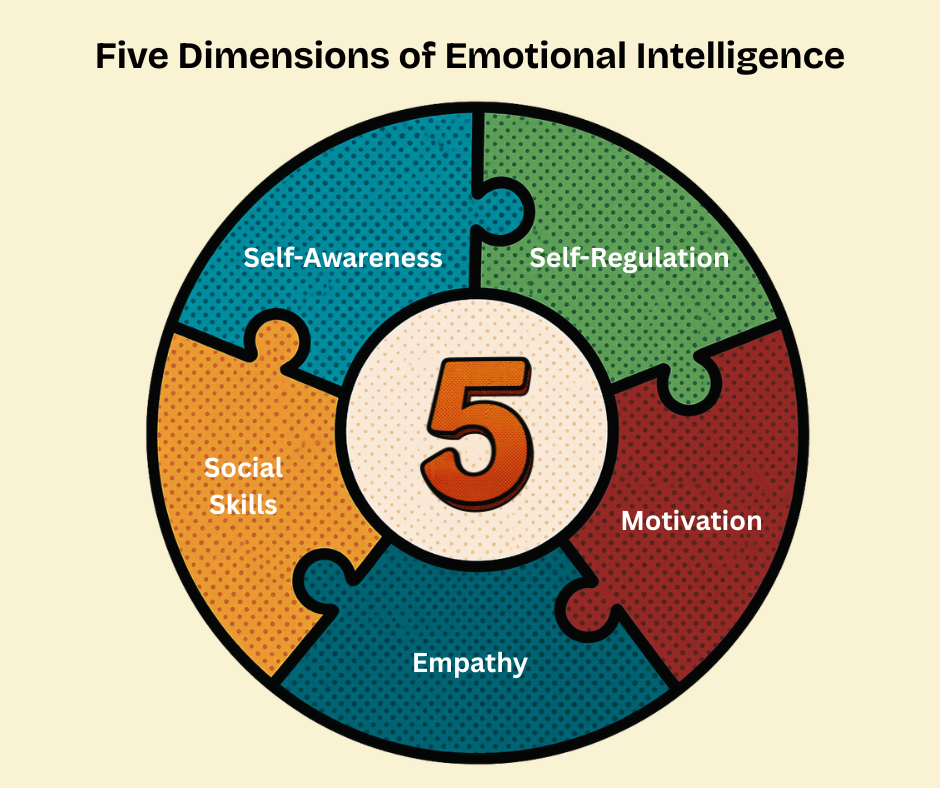
Self-Awareness is the cornerstone. It is the capacity to recognize, in real time, what you are feeling, what is driving that feeling, and how it is shaping your behavior. Every other dimension stands on this one. A 2024 Cogent Business & Management study of SME managers found that self-aware leaders consistently make better decisions, communicate more effectively, and coordinate their teams more successfully. Self-awareness is your dashboard.
Self-Regulation is the pause between stimulus and response. It is not about suppressing emotion — that backfires every time — it is about feeling what you feel without being ruled by it. It is what allowed Sarah to read a difficult email, set it aside for twenty minutes, and respond from a clear head. It is what Daniel lost every time a deal went sideways. Walter Mischel's decades of "marshmallow" research showed that the ability to regulate impulses predicts better outcomes across almost every domain of life.
Motivation in the EQ framework is not hype, pressure, or hustle. It is the internal fuel that keeps you moving when progress is slow and the payoff is far away. Intrinsic motivation — tied to purpose, curiosity, growth — is sustainable fuel. Extrinsic motivation — fear, comparison, external rewards — burns hot but runs out fast. The motivation you are running on right now is quietly shaping every decision you are making today.
Empathy is the capacity to accurately read what is happening inside other people — your team, clients, prospects, partners — even when they cannot articulate it themselves. Empathy is not niceness; it is perception. In sales, it is the difference between pushing a product and offering a solution. In leadership, it is the difference between a team that compliantly executes and a team that genuinely trusts you.
Social Skills are where the first four dimensions become visible. This is the outward expression of everything happening inside — how you communicate, build trust, influence without manipulating, and navigate the difficult conversations every business eventually requires. Social skills are not about being charismatic or extroverted. What the most emotionally intelligent leaders share is effectiveness in relationship.
Same Business, Different Outcomes
Come back to Daniel and Sarah with that lens in place, and the difference between them stops being mysterious.
Sarah had, over years of intentional work, developed a relatively healthy inner operating system. She knew her patterns. She could feel herself starting to react and take a breath before responding. She was clear about what was motivating her, and she could tell when a goal had drifted into "prove something" territory. She read her clients accurately and could have hard conversations without collapsing or escalating.
Daniel's inner operating system was running in the background, unexamined. His self-awareness had real gaps. His self-regulation buckled under pressure. His motivation had quietly shifted from building something meaningful to not being seen as a failure — and that fuel was toxic. He misread his team's emotions and kept wondering why they were leaving.
Two businesses. Same market. Same skills on paper. Different trajectories — and the divergence point was never about strategy. It was about the operating system underneath the strategy.
Your Assignment This Week
Here is the gentle but powerful work I want to invite you into this week. You do not need to overhaul anything — you just need to look.
Find thirty quiet minutes. Pour a cup of coffee, open a notebook, and walk yourself through these four questions. Just you and the operating system that runs your business.
1. Notice what runs in the background. Think of a moment in the last thirty days when you felt yourself react in your business — a difficult email, a missed number, a prospect who went quiet. Write what happened externally in one sentence, then what happened inside you in three. Putting it on paper is the first act of self-awareness.
2. Ask what dimension was in charge. Looking at the moment you just described, which of the five dimensions — self-awareness, self-regulation, motivation, empathy, social skills — showed up strongly for you? Which one went offline? This is not about grading yourself. It is about beginning to see the pattern.
3. Trace the pattern back. How often does that same internal sequence play out? Not just with this client, but with clients like this. Not just with this team member, but with team members like this. Patterns reveal the shape of your operating system far more clearly than isolated events ever will.
4. Name what your motivation is actually running on this month. Is your fuel coming from purpose and a picture of growth that feels alive to you — or from pressure, fear of falling behind, or proving something? No wrong answer. You cannot redirect fuel you have not yet identified.
If something uncomfortable surfaces, that is not a problem — it is evidence your dashboard is starting to light up. The patterns that run us most powerfully are the ones running underneath our awareness. Seeing them is the first act of taking them off autopilot.
If You Want to Go Deeper
If this conversation about your inner operating system has sparked something in you — if you suspect there is a clearer picture of how you are actually wired just outside your current line of sight — that is exactly what the Entrepreneurs Edge™ Ecosystem was built to illuminate.
The assessment itself is only the starting point. The Ecosystem is the full service — a complete map of your inner operating system and a practical pathway built around it. Here is what is included:
Complete Multi-Dimensional Assessment Battery — The Entrepreneurs Edge™ Assessment (48 real-world business scenarios across the five dimensions), expanded with behavioral profiling, motivational drivers, and additional instruments selected for your situation. No two people get the same battery, because no two people have the same operating system.
EQFIT® Habit Profile™ — The centerpiece. One integrated view of your entire battery: Habit Snapshot with SWOT, EI Integration Map, Behavioral and Motivational DNA, Conflict Patterns, Cross-Assessment Patterns, Growth Edge Priorities, 90-Day Action Roadmap, and Coaching Conversation Guide.
Personalized Client Acquisition Playbook — Custom conversation flows and channel-specific strategies for email, phone, virtual, and in-person business development — calibrated to who you actually are, not a generic script. Includes a Quick Reference Card for real-time use.
Business Model Roadmap and Guide — A personalized guide to a business model that fits your wiring — strategy, client approach, team structure, daily rhythms, and growth plan all aligned with who you actually are.
Technology Integration Strategy — A practical plan for putting AI and technology to work in your business, built around your readiness and matched to where you will get the most leverage.
All Assessment Reports and Workbooks — Quick Results Summaries, Development Reports, Growth Workbooks, and Coaching Reports for every assessment in your battery. The complete library — every dimension mapped and actionable.
Multiple Recorded Coaching Sessions with Steve Goodner — A deep debrief of your full assessment picture, a roadmap session to translate insights into your specific pathway, and an integration session after you have begun implementing. All recorded so you can revisit key insights anytime.
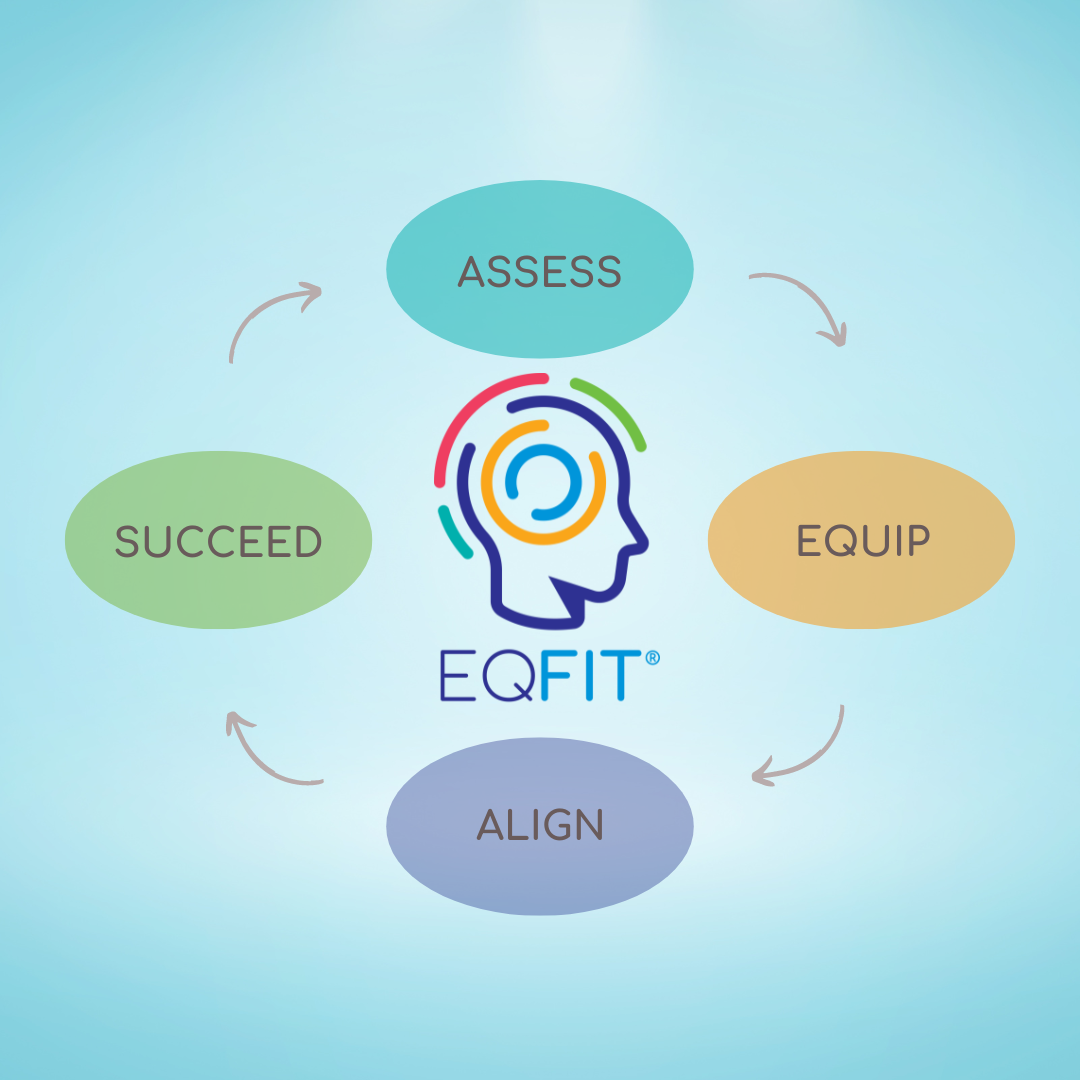
The whole Ecosystem is built on
the EQFIT® rhythm
— Assess, Equip, Align, Succeed —
so that success becomes less about hustle
and more about flow.
Learn more at eqfit.org.
Next week, we will go deeper into the first and most foundational of the five dimensions — self-awareness. We will explore why self-awareness is the root beneath every great business decision, and why developing it may be the single highest-leverage move any entrepreneur can make this year.
Until then, take the thirty minutes. Look at your operating system. You cannot read the label from inside the jar — but you can loosen the lid.
Copyright © EQFIT® — Author: Steven Goodner. All rights reserved.