
Why Your Best People Aren’t Giving You Their Best Ideas
Psychological Safety:
Why Your Best People
Aren’t Giving You Their Best Ideas
The Thriving Business Ecosystem — Week 14 of 40
More Success with Less Stress
June 2026
Michael ran a twenty-two-person structural engineering firm in Kansas City. Smart people. Deep bench of licensed PEs. Reputation strong enough that his phone rang without any marketing budget behind it. He had built the practice over seventeen years on precisely the kind of technical excellence his industry rewarded, and by every external measure, his shop was one of the best in the region.
What Michael could not figure out — and what had brought him to my office on a rainy Wednesday — was why his weekly project reviews had become the quietest meetings in the building. He would present the week’s challenges, walk the team through the trickiest calculations, and ask the same closing question he had asked for a decade. “Any concerns? Anything I’m missing?” And the room would give him the same answer every week. Polite nods. A couple of nothing-questions. Then everyone would file back to their desks.
Michael would have believed the quiet meant everyone was fine — except for one small thing. On a Thursday afternoon three weeks earlier, he had walked back to his office and passed two of his best young engineers standing at the coffee machine. They did not see him. And he overheard, in the space of about twenty seconds, one of them saying to the other, “We should have flagged the load path issue on the Weston project. I saw it in the meeting. I just didn’t want to be the one to say it.”
Michael stood outside the doorway of his own office for a full minute. Then he walked in, sat down, and stared at his screen without touching it. Then he did the thing he had always done when he could not make sense of something. He picked up the phone.
“Steve. I think we might have a psychological safety problem. But I have no idea how you have one of those without knowing it.”
The Best Ideas Are Already in the Room. They Just Are Not Making It Out.
Last week we sat with boundaries — the shape of a healthy relationship. This week we look at the other side of the same soil condition. Because a boundary tells your people what is not okay to bring into the room. Psychological safety tells them what is okay to bring in — and, more importantly, whether they will pay a cost if they do.
Most small business owners believe their team is telling them what they actually think. Michael believed it. Karen from a few weeks back believed it. Jeff believed it. Every one of them was wrong — not because their people were dishonest, but because their people had quietly calculated, conversation by conversation, that some ideas were safer to share than others, and that some ideas were safer left for the parking lot.
Here is the line I want you to underline before we go further. Psychological safety is not the belief that no one will disagree with you. It is the belief that you will not be punished — socially, emotionally, or professionally — for saying the thing that needs to be said. That is a very specific belief. Your team is holding one version of it about you right now. And whatever that version is, it is quietly determining what ideas make it into the room and what ideas stay at the coffee machine.
Why the Absence of Dissent Is Almost Always the Wrong Kind of Signal
The single largest study of team effectiveness in the modern era — Google’s internal Project Aristotle, which studied more than one hundred and eighty of their own teams over two years — set out to find the specific combination of talent, tenure, and personality that produced their highest-performing teams. What they found instead was that no combination of individual traits predicted team performance at all. The single strongest predictor, by a considerable margin, was psychological safety.
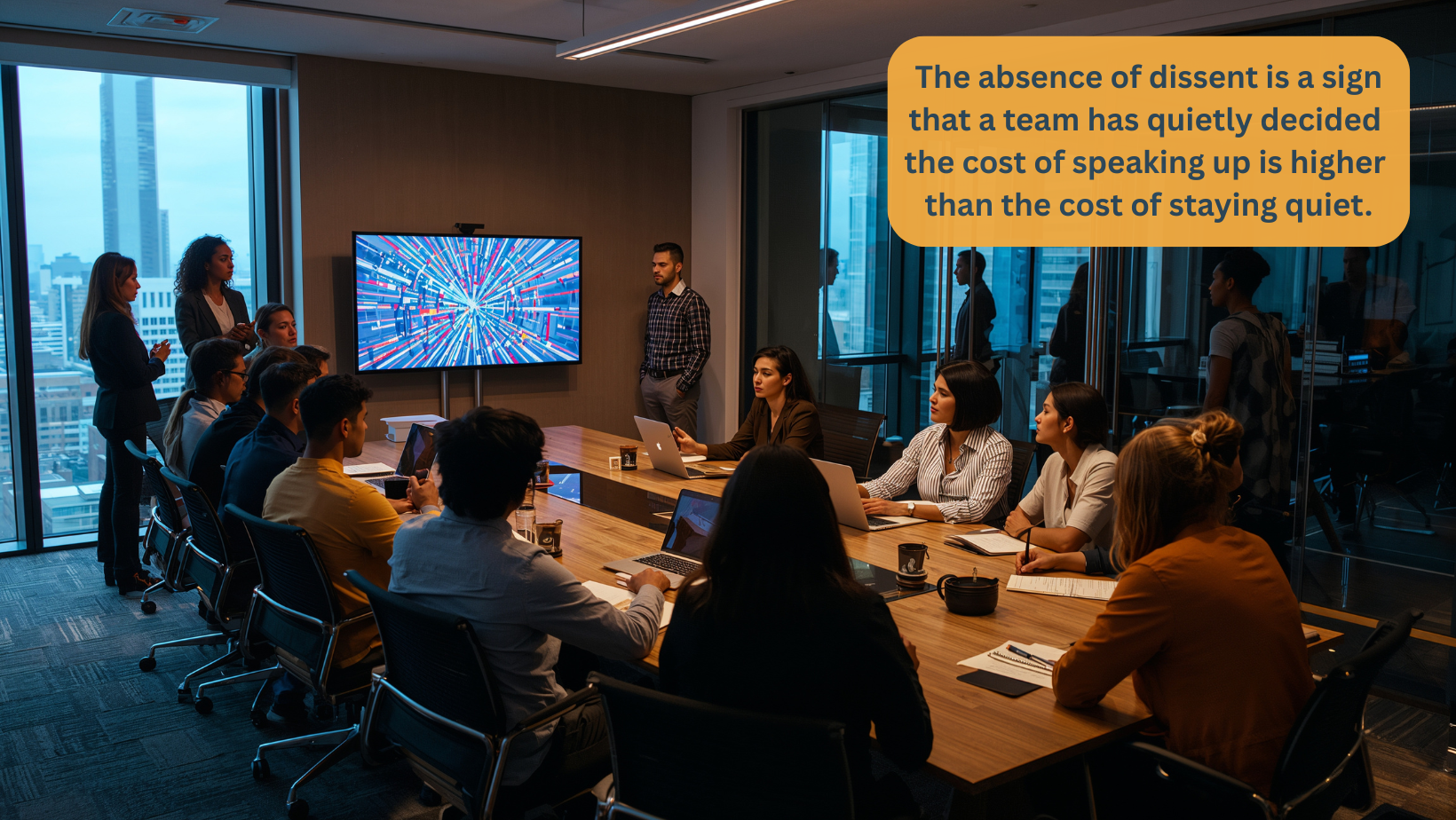
Amy Edmondson at Harvard Business School, who did the foundational research on this decades earlier, found something even more striking. In her original studies, higher-performing hospital teams reported more errors — not because they made more, but because they were safe enough to name them. The teams reporting fewer errors were not making fewer. They were hiding them. The absence of dissent, in Edmondson’s work and in every study since, is almost never the sign of a healthy team. It is the sign of a team that has quietly decided the cost of speaking up is higher than the cost of staying quiet. And every quiet meeting is a small tax that team is paying on the future of the business.
The Four Voices Your Team Is Trying to Decide Whether to Use
Edmondson and others have surfaced four specific kinds of contribution your team members are silently deciding, meeting by meeting, whether it is safe to share with you. The healthy company is the one where all four voices reach the room.
The first voice is the question voice. “I do not understand this.” “Can you explain that?” “Why are we doing it this way?” In low-safety climates, the question voice is the first one to go silent — because the person asking is quietly calculating that looking uninformed costs more than staying confused. When the question voice disappears, the team quietly starts making decisions on assumptions no one has tested.
The second voice is the concern voice. “I am worried about this.” “I think we may have missed something.” “I have seen this pattern before and it did not end well.” The concern voice is the one your two engineers at the coffee machine were using — but had already decided was too costly to use in the room. When the concern voice disappears, the team loses its early-warning system.
The third voice is the idea voice. “What if we tried something completely different?” “I have been thinking about this and I want to run it by you.” In low-safety climates, the idea voice retreats into notebooks and private conversations because half-baked ideas feel dangerous to share aloud. When the idea voice disappears, the company slowly stops innovating — and the owner is usually the last person in the building to notice.
The fourth voice is the mistake voice. “I got that wrong.” “That was my call, and it did not work.” “I want to raise something before it becomes a bigger issue.” The mistake voice is the one Edmondson’s hospital research found most predictive of high-performing teams — not because mistakes were welcome, but because catching them early was. When the mistake voice disappears, small errors quietly compound into the ones that eventually cost you a client, a contract, or a hire.
Your Assignment This Week
Psychological safety is not built in a training. It is built in the small moments when your people are quietly deciding whether to use one of the four voices — and reading, from you, whether it is safe. Run any three of the four practices below this week.
1. The Post-Meeting Voice Audit. After your next leadership meeting, sit for five minutes on paper. Which of the four voices — question, concern, idea, mistake — actually showed up in the room? Which ones did not? Do not conclude anything yet. Just notice. Most owners running this audit for the first time discover that the same one or two voices go missing every week — and that they are almost always the voices most likely to protect the business.
2. The Question-Voice Invitation. In your next meeting, ask one specific version of a question you have never asked directly. “Where in this plan are you uncertain?” or “What would you have done differently, if this had been your call?” Then wait longer than feels natural. The silence is not resistance. It is your team deciding whether the invitation is real. If you fill the silence, you have just taught them it was not. If you wait, you will hear the room differently within two meetings.
3. The Public Mistake Rep. Find one small mistake or misjudgment you made in the last thirty days and name it, briefly and un-fussily, in front of the team. Not a confession — a calibration. “That call I made on the Weston timeline last month? I got it wrong. Here is what I would do differently next time.” A single, honest public mistake rep from the owner will change the temperature of the room faster than any training program. Your team is watching for the signal that mistakes are allowed. You are the only person in the building who can send it.
4. The Two-Question Debrief. For your most important project this quarter, run a fifteen-minute debrief with the team on two questions only. What did we get right? What did we miss, and how could we have caught it earlier? Do not skip the second question. Do not let the room off the hook for the second question. The very act of running the debrief — publicly, calmly, without blame — is itself a psychological safety signal your team is measuring you against.
If you take only one of these four into the week, take the third. The Public Mistake Rep is uncomfortable, brief, and the single most powerful psychological safety signal an owner can send. It teaches your team, more clearly than any invitation you could issue, that the mistake voice is safe here. And once that voice starts moving, the other three follow almost on their own.
When Michael ran the Public Mistake Rep in his next project review, he did not make a speech. He walked into the room, opened his laptop, and said, “Before we start today — I want to name something about the Weston project. There was a load path issue in our early calculations. I heard about it after the fact. I do not want that to happen again, and I want to be clear that the way to make sure it does not is not for people to raise it more carefully in the parking lot. It is for me to make it safer to raise in this room. I am working on it. Thank you for your patience with me while I do.” The room went completely still. And then, for the first time in fourteen months, one of the two young engineers from the coffee machine cleared his throat and said, “Michael, actually — on the next project, I have a concern I want to flag.” The soil had just shifted. The best ideas in Michael’s firm were not somewhere else. They had been in the room the whole time.
If You Want to Go Deeper
Psychological safety is one of the highest-leverage soil conditions a leader ever cultivates — and one that is almost impossible to see from the inside, because the person setting the climate is the same person whose signals are being measured. Guide’s Edge™ is the EQFIT® framework built for the leaders, managers, and coaches who are quietly shaping which voices reach the room and which stay at the coffee machine. It maps how your presence is landing, where the four voices are safe with you and where they are not, and what the smallest, most durable practices look like for shifting the climate. If your meetings have gone quieter than your business can afford, the work is here. Learn more at eqfit.org, or simply reply to this post.
Next week we move from the voices your team is deciding whether to use to the moment those voices go silent for good — the moment your best people give notice. The post is titled “When Good People Leave: What Your Ecosystem Is Telling You.” I will see you there.
Copyright © EQFIT® — Author: Steven Goodner. All rights reserved.