
Systemizing Without Losing Your Soul
Systemizing Without Losing Your Soul:
The Human Side of Efficiency
Why the Right Systems Don’t Cage Your Craft — They Set It Free
The Thriving Business Ecosystem — Week 33 of 40
More Success with Less Stress
Author: Steve Goodner
November 9, 2026
The Recipe Teresa Kept in Her Head
Teresa was still in the shop at a quarter to midnight, piping the last rosette onto a three-tier cake, when she realized she couldn’t remember whether she’d ordered the gold leaf for Saturday.
She ran a custom-cake studio — four people, a wall of five-star reviews, and a reputation that brought brides from three counties over. For nine years, everything had lived in one place: her head. The buttercream recipe that tasted like someone’s grandmother had made it. The trick to keeping ganache from splitting in July humidity. The supplier to call when the first fell through. She was proud of it. “My hands know the recipe,” she liked to say. “You can’t write down a feeling.”
But that night she’d nearly missed a wedding order — a bride’s once-in-a-lifetime cake — because the only calendar that truly mattered was the one behind her own tired eyes. And it wasn’t the first near-miss. Her team kept asking her to “write things down so we can actually help,” and every time, something in her flinched.
She called me the next morning, flour still on her sleeve. “Steve, everybody keeps telling me to systematize. Build processes. Make checklists. But every system I’ve ever seen turned something warm into something cold — a script, a factory, a drive-through. People drive an hour for my cakes because they can taste that a real person made them. I’d rather drown doing this with love than run a machine.” She paused. “So why am I so exhausted I’m starting to resent the thing I built my whole life around?”
If you’ve ever believed that putting your business on rails would squeeze the soul right out of it — this one is for you. Because after forty years of watching owners wrestle with exactly this fear, I’ve come to believe the opposite is true. The right systems don’t cost you your soul. They’re how you finally get to keep it.
The Insight: A System Is a Trellis, Not a Cage
For several weeks now we’ve been living in what I call climate control — the layer of your ecosystem that technology, automation, and AI are reshaping whether you invited them to or not. The posture has held the whole way through: a greenhouse doesn’t fear the weather, and it doesn’t fling its doors open to every passing gust either. It works with the climate on purpose. Last week we turned from the tools to the person holding them. This week we pick up the promise I left you with — that the goal was never a more automated business, but a more human one, running on better rails. So let’s talk about the rails. And let’s begin by taking Teresa’s fear seriously, because it isn’t foolish. It’s wise.
Honor the Fear — Some Systems Really Do Kill the Soul
Teresa isn’t wrong that systems can flatten something beautiful — the service script that makes a person sound like a vending machine, the funnel so automated you can smell the machinery. Those systems earn the suspicion; they were built to replace the human, not to free her. So when your gut tightens at “just systematize it,” that instinct is protecting the very thing your customers pay you for. We’re not going to override it. We’re going to aim it.
The Two Kinds of Work
Here’s the distinction that changed everything for Teresa. In every business there are two kinds of work, and we almost always confuse them. There’s robotic work — repeatable, rules-based, the same every time: ordering supplies, booking the calendar, sending the invoice, the standard steps that don’t need your soul to do well. And there’s relational and creative work — the design conversation with a nervous bride, the taste only your palate can judge, the decision that needs your forty years of instinct. Teresa heard “systematize” and pictured her artistry on an assembly line. But no one was asking her to. The only real question was whether the robotic third of her week should keep stealing the energy her artistry needed. A system aimed at the robotic work isn’t an assault on your craft. It’s a bodyguard for it.

A Trellis in the Greenhouse
Think about what a good gardener does with a tomato vine. Left on the ground, the vine sprawls, the fruit rots in the dirt, and the plant pours half its energy into simply holding itself up. So the gardener adds a trellis — not a cage, but support that lets the vine climb toward the light and spend its energy where it belongs: on fruit. That is exactly what a system is meant to be for your business. Not a cage around your soul, but a trellis for it — structure that carries the dead weight so your creativity, your judgment, and your presence can climb. Teresa didn’t need fewer feelings in her work. She needed a trellis strong enough to hold them up.
The Technician’s Trap
There’s a reason so many gifted owners end up exactly where Teresa was. Michael Gerber named it decades ago in The E-Myth Revisited: the fatal assumption that because you’re good at the work, you should own a business that does that work. The baker opens a bakery — and then spends less and less time baking, buried under everything the business needs just to survive. The craft that started the whole thing becomes the one thing there’s never time for. Gerber’s answer wasn’t “work harder”; it was to build systems so the business doesn’t depend on you being heroic every single day. The refinement the EQFIT® lens adds is simply this: systematize the robotic, protect the relational. Put the repeatable work on rails precisely so the irreplaceable work can have you at your best.
Your Judgment Is a Depletable Resource
And this is where the science makes the case even sharper. Your best judgment — the warm, wise, creative decision-making that is your whole value — is not a bottomless well. Researchers call the drain decision fatigue, and it is very real. In a now-famous 2011 study in the Proceedings of the National Academy of Sciences, researchers tracked a thousand parole rulings by experienced judges. First thing in the morning, judges granted parole about 65 percent of the time; by the hour before a break, as the rulings piled up, that rate had fallen toward zero — then rebounded once they’d rested. Same judges, same cases. The only thing that had changed was how depleted their judgment had become. We make tens of thousands of small decisions a day, and every trivial one — where’s the order form, who was supposed to call the supplier — draws from the same tank you need for the decisions only you can make. And that drain is fed by a robotic layer bigger than most owners guess: the McKinsey Global Institute found that about 60 percent of occupations have at least 30 percent of their activities that a system could handle. That’s good news, not a threat — a system that captures that third isn’t stealing your craft; it’s clearing the bench so you can get back out and play your position. When Teresa refused to systematize the small stuff, she wasn’t protecting her artistry. She was quietly starving it.
The Piece You Can’t See
And just like the puzzle box we keep returning to, the piece that matters most is the one you can’t easily see. The checklists and tools sit on top of the box, in plain view. But underneath Teresa’s resistance sat a hidden piece: a quiet belief that if the work could run without her, she wouldn’t matter anymore. That belief — not the systems — was the real cage. You can see some of your pieces; some you can’t; the real question is how they fit the bigger picture. And here is the test that tells a trellis from a cage, the same one we used last week moved a layer out: does this system free my humanity, or replace it? A system that readies you to be fully present with a customer frees you; one that stands in for you with that customer replaces you. The first builds trust; the second erodes it. Or, as I’ve said for forty years about the science I love: the system serves the person, never the other way around.
The Application: Build the Trellis This Week
You don’t protect your soul by refusing to build systems. You protect it by building the right ones, in the right order — robotic work on rails, human work set free. Pick two or three of these this week.
Sort your week into R and H. Take one blank page and list every recurring task in a typical week. Beside each, write R for robotic (repeatable, rules-based, doesn’t need your soul) or H for human (judgment, creativity, relationship — only you). Don’t fix anything yet; just see it. Most owners are startled by how many R’s they’ve been guarding as if they were H’s.
Document the one thing that would sink you. Pick the single task that lives only in your head and would cause a disaster if you were out sick for a week — Teresa’s wedding calendar, your follow-up sequence, the login nobody else has. Write it down once. Not to make it generic — to make it survivable. A recipe card doesn’t cheapen the cake; it makes sure there’s a cake when your hands can’t be there.
Name where you’re the bottleneck. Finish this sentence honestly: “Nothing in my business can move forward without me when it comes to ____.” That’s not a badge of honor — it’s a ceiling on your growth and a single point of failure on your busiest day. Choose one item to hand to a system or a person this month.
Build the trellis around the human moment, not over it. Pick your most personal customer touchpoint — the one they’d miss most if it vanished. Then build the system that readies everything around it, so you arrive with nothing left to finish and your whole self available. Guard what renews the relationship as fiercely as you automate what drains you.
Take the vacation test. Ask the uncomfortable question: could my business deliver its signature experience for two full weeks without me in the building? Design toward yes — not so you can disappear, but so it stops depending on you running on empty.
And sit with two questions this week. First: When I refuse to write something down, what am I really protecting — the soul of the work, or my own need to feel indispensable? Second: If the right system gave me back my sharpest, warmest energy, where would I spend it so a customer felt more known rather than more processed? The first question finds the cage. The second tells you what the trellis is for.
Going Deeper
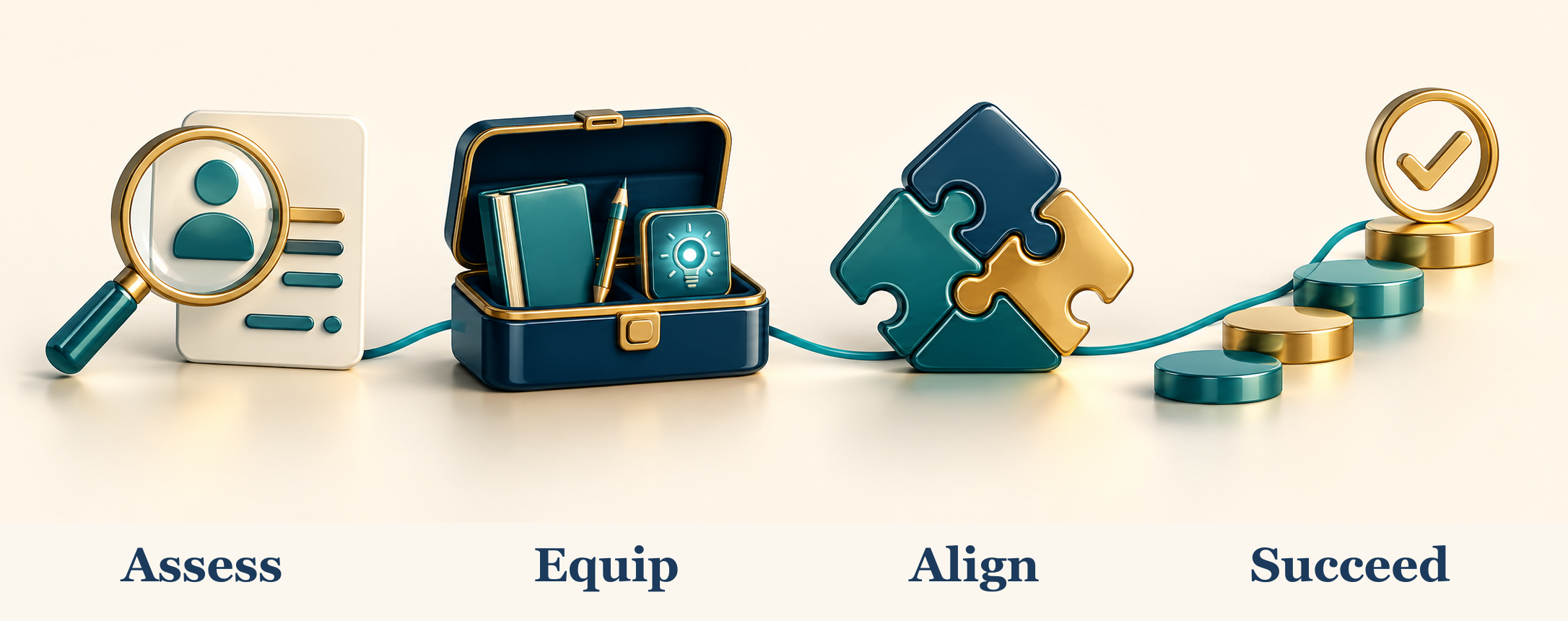
If Teresa’s midnight exhaustion sounded even a little like your own, take heart: you are not behind, and you do not have to choose between a business with a soul and a business with systems. You can have both — in fact, past a certain size, you can’t keep the soul without the systems. But the order matters, and it’s the part most people get backward: you can’t systematize your way to alignment. You have to see how you’re actually wired first — your strengths, your drivers, the patterns that decide which work is truly yours — then build the rails around that person, not a generic template. That’s the whole EQFIT® approach: Assess → Equip → Align → Succeed. It’s what Your SuccessPath™ is built to do — turn a clear picture of who you are into a 90-day roadmap of daily rhythms and systems designed around your actual nature, so your business runs on rails that fit you instead of fighting you. For a first, no-pressure look at the pieces on your own puzzle box, start with the free Success Pathway Snapshot at eqfit.org. That’s the Assess in Assess → Equip → Align → Succeed — and it’s where more success with less stress begins.
Next week we stay in climate control one last time and lift our eyes to the horizon. In “Future-Proofing Your Business: Adaptation as a Core Competency,” we’ll look at why the businesses that last aren’t the ones that guessed the future right, but the ones that built the capacity to adapt — and how agility and resilience become the operating system of a business that’s ready for anything. Bring your R-and-H list with you.
© 2026 — EQFIT® — All rights reserved.